![[personal profile]](https://www.dreamwidth.org/img/silk/identity/user.png)
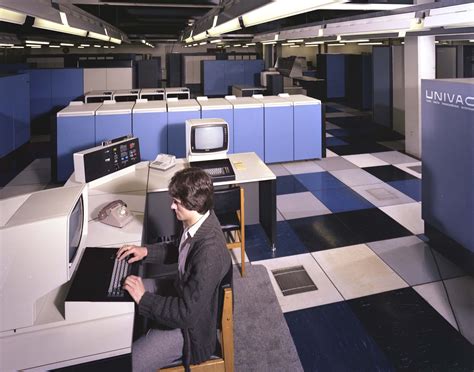
The Multics project was part of a general current in computing development that came too late and was predicated to be overtaken and made obsolete by another current before it could ever be realized.
The reason for Multics and UNIX
Mainframe systems were too large and expensive to be operated by a single person. They were a collective endeavor and required a large team of people with different roles working seamlessly together. Programs were written on a desk and then forwarded to other people who would add and execute the programs, only to return the results back to the desk where the program came from after many hours. Because many programmers made use of the same computer system and the system could only digest one order at a time, the whole process from a request for execution to receiving the output could take days.
Computing was an expensive business
Like said, in the beginning these large computers had to be operated by an army of people and could only conduct one program at a time, rendering parts of the machine idle while other parts were active. On top of that, the machine had to be setup again for each program. All these aspects made running a program very time and work hour costly.
Time * salaries = $$$ You got the point. To give an example, at t the end of the 1960's it costed 50-75 USD to run Kenneth Thompson's Space Travel video game just one time.
Computer scientists developed basically three solutions to make computing more time efficient & affordable:
1) batch programming: the capability to queue orders so that the computer only needed to be set up one time for conducting a series of programs.
2) allow the machine to use different compartments of its electronics for different programs simultaneously
3) timesharing: make computers usable by more than one input/output units at the same time. Such units would be called terminals or workstations and these were connected to the same central computer.. The computer would freeze a program and continue another alternately to ensure the most efficient sequence, depending on which parts were idle etc. For the individual station user it felt as if they were working independently on their own personal computer system. Multics was meant to be a very advanced form of this kind of centralized shared computing system allowing for more than 100 workstations to be run with one large centralized computer.
4) make hardware so small and cheap that every user can have their own mini computer.
Before Multics, which was an advanced idea that was complicated to put in practice, could be fully developed, the fast rate of the microcomputer development made the concept already obsolete before inception.
In the ashes of Multics arose UNIX, for which the Bell Labs team took some innovative ideas from Multics and instead of using these for centralized computing, like they were doing with the GE-635 mainframe, they ported them to a microcomputingsystem: first on the PDP-7 and later on the PDP-11. Thanks to the development of the C language and the the building of a UNIX OS entirely with C, the OS got eventually ported to many different hardware configurations.


