![[personal profile]](https://www.dreamwidth.org/img/silk/identity/user.png)
PS I synthesize here in my own words what K&R teach, re-write all their example programs, character by character, solve all the C exercises they hand out. I comment to what K&R teach cursively. I do not copy-paste anything from the book! In regards to the percentages listed: books often have prefaces with Roman numbers and often also lengthy Appendices. In my calculation I include all pages that I effectively study and synthesize.
TCPL 2Ed - Page 0006 to 006 - 3.77% Completion
1.1 Getting Started
According to the writers, the best way to learn C is by writing C programs.
k-r_prg001.c
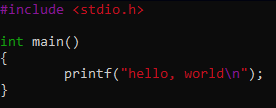
Programs are written in text files with the extension .c
To run a c file it must first be compiled into an executable file.
In Linux command line the command to compile with gnu-gcc is:
gcc [filename].c -o [filename].out
In Unix/Linux these have the extension .out, in Windows .exe.
In Unix command line, with cc the file is compiled by running cc [filename]. (in Linux that is gcc, with the gnu-gcc compiler).
Next, the executable is launched by simply executing ./[filename] (a compiled file with .out or .exe as extension).
Output of k-r001.c after compiling:
k-r_prg001.out

TCPL 2Ed - Page 0006 to 006 - 3.77% Completion
1.1 Getting Started
According to the writers, the best way to learn C is by writing C programs.
k-r_prg001.c
Programs are written in text files with the extension .c
To run a c file it must first be compiled into an executable file.
In Linux command line the command to compile with gnu-gcc is:
gcc [filename].c -o [filename].out
In Unix/Linux these have the extension .out, in Windows .exe.
In Unix command line, with cc the file is compiled by running cc [filename]. (in Linux that is gcc, with the gnu-gcc compiler).
Next, the executable is launched by simply executing ./[filename] (a compiled file with .out or .exe as extension).
Output of k-r001.c after compiling:
k-r_prg001.out


