![[personal profile]](https://www.dreamwidth.org/img/silk/identity/user.png)
PS I synthesize here in my own words what K&R teach, re-write all their example programs, character by character, solve all the C exercises they hand out. I comment to what K&R teach cursively. I do not copy-paste anything from the book! In regards to the percentages listed: books often have prefaces with Roman numbers and often also lengthy Appendices. In my calculation I include all pages that I effectively study and synthesize.
Statements of a function exist between braces: {}A function is called by naming it, like printf followed by parenthesizes that contain the arguments, "hello, world\n", which in this case is a character string or string constant . For now, the authors state, they will only use character strings as arguments for functions.

The character \n is the C syntax for the new line character. This symbol,when printed, pushes he following characters to the next line.
No matter if several lines are used while writing the C files, without the \n the characters will all be printed on the same line.
\n represents a single character. Similar characters are:
\t = tab
\b = backspace
\* = double quote
\\ = backslash
Etc.
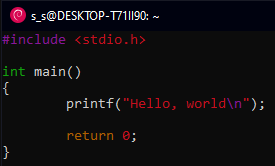
k-r_exc1-1.c
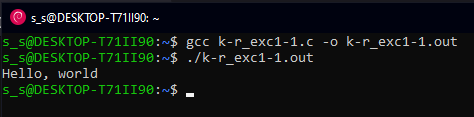
k-r_exc1-1.out
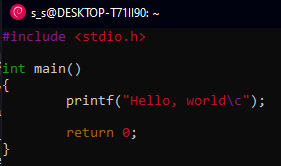
k-r_exc1-2.c
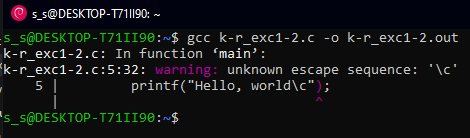
k-r_exc1-2.out